Healthcare, Reimagined Through Disease-Specific AI
AyurLekh's AI story is disease-specific and status-labelled. It is designed as an intelligence layer around healthcare professionals, not autonomous diagnosis.
AI should make doctors more capable, not make doctors irrelevant.
AI can structure symptoms and history, organise reports, support clinically appropriate imaging workflows, reduce repetitive documentation and highlight information that may deserve clinician review.
Problem → approach → workflow → capability → status.
Every AI/R&D card carries a visible status badge.
| Vertical | What it covers | Website status |
|---|---|---|
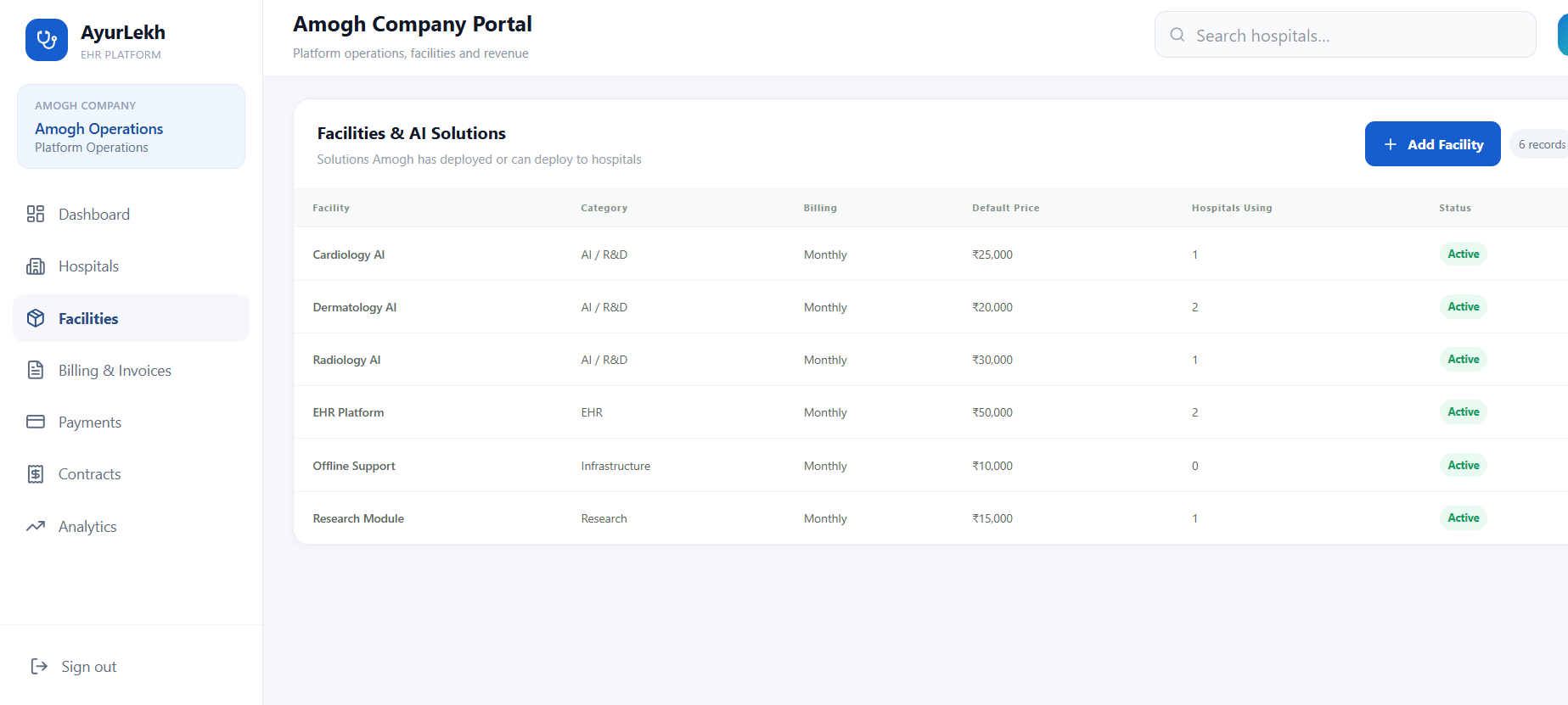
| Dermatology AI | Disease-specific workflows, AI-assisted analysis, image/report workflows, patient segmentation. | IN DEVELOPMENT |
| Cardiology AI | Disease-specific workflows, clinical data analysis, AI-assisted insights. | IN DEVELOPMENT |
| Radiology AI | Imaging workflows, X-Ray/CT/MRI, DICOM support, AI-assisted imaging. | IN DEVELOPMENT |
| Research Module | Disease-wise research, structured clinical data, privacy-aware collaboration, federated-research direction. | R&D ROADMAP |
The reference proposal explicitly says the clinical AI is not yet a validated diagnostic product, so the site does not make clinical-accuracy or diagnostic claims.
Human oversight
AI outputs support rather than silently replace clinical judgement.
Validation
Clinical claims should be supported by evidence and evaluation.
Transparency
Users should understand what the system can and cannot do.
Escalation
Higher-risk or uncertain cases should be surfaced for professional review.
Explore each AI vertical.
See the problem, approach and status separately.